P00.05 · Lesson 05 of 15
Units & Dimensional Consistency
A number without a unit is not a measurement. A spacecraft was lost to one.
Build it Unit-checked calculations with pint; Mars Climate Orbiter post-mortem
- Learning outcomes
- Derive the conversion factor between any two units of the same dimension from the definitions of the base units, and check it by a round trip.
- Implement unit-checked engineering calculations with
pint, so that a dimensionally wrong operation raises an error instead of returning a number. - Decide, for a given function interface, whether the units are carried by the data or by the documentation, and name the failure that each choice invites.
- Reconstruct the Mars Climate Orbiter small-forces error numerically and explain why no single engineer could have seen it in the numbers.
- Prerequisites
P00.01,P00.03; skill check: you can rearrangeF = m afor any variable and state the SI unit of each.- Engineering question
A ground program writes a thruster impulse as a bare number into a file; a navigation program reads it. How large is the trajectory error if the two programs disagree about the unit, and how would you make that disagreement impossible rather than unlikely?
Full lesson specification (11 more items)
- Assumptions and limits
pintchecks dimensions and converts units; it cannot know that a quantity labelled "velocity" is airspeed rather than ground speed, or that a temperature is absolute when you meant a difference. Conversion factors here are exact SI definitions; measured constants (e.g.gat a site) are not. The MCO re-enactment uses illustrative firing sizes and spacecraft mass, not the mission's data.- Analytical work
The pound-force in newtons from the definitions of the pound and standard gravity; dimensional analysis of impulse, velocity change and specific impulse; the order of magnitude of a navigation error from an accumulated impulse error.
- Computational deliverable
main.pywith a singleUnitRegistry,round_trip,magnitude_in,add_checked,dynamic_pressure,total_impulse,delta_v, and the MCO functionslbf_s_to_N_s_factor,mco_misread_impulse,accumulated_delta_v_error. Tests prove: round trips return to within 10⁻¹² relative, a mismatched addition raisesDimensionalityError, swapped arguments are rejected, and the lbf·s/N·s factor equals its exact definition.- Practical activity
data-based investigation: read the Mars Climate Orbiter Mishap Investigation Board report and reconstruct the chain from a unit mismatch to a 170 km altitude error.
- Equipment
None.
- Safety
None beyond normal computer use.
- Evidence
Your
main.py, passing tests, and a one-page causal chain for the MCO loss in your own words with the unit error placed correctly within it.- Assessment
assessments/phase-00/grading-rubric.md; competencies 2 (analytical problem solving), 3 and 4; pass: all public tests green, Problem 2 derivation correct to the exact factor, causal chain names the root cause and at least three contributing causes.- References
@pint-tutorial"Initializing a Registry", "Defining a Quantity", "Converting to different units", "String parsing", "String formatting" (required-free).@nasa-mco-mibMars Climate Orbiter Mishap Investigation Board Phase I Report, 1999-11-10, sections on the root cause and contributing causes (required-free).- Extensions
★ Wrap a NumPy array in a
Quantityand vectorizedynamic_pressureover a flight log. ★ Write apintcontext that converts between geometric altitude and pressure altitude using the ISA model.- Time
unmeasured
1. The engineering problem
On 23 September 1999 the Mars Climate Orbiter fired its engine to enter orbit around Mars, passed behind the planet, and was never heard from again. The Mishap Investigation Board's Phase I report, published seven weeks later, found that the spacecraft had reached Mars about 170 km lower than planned, deep enough into the atmosphere to be destroyed. The root cause it names is a unit error: a ground-software file called "Small Forces" reported the impulse of each small thruster firing in pound-force-seconds, while the navigation software that consumed the file, following the written interface specification, treated the numbers as newton-seconds. Every firing was booked as 4.45 times smaller than it really was. Over nine months of cruise, the small discrepancy in the modelled trajectory accumulated into a fatal one.
Nothing in the numbers looked wrong. The file contained plausible values. The navigation solutions were self-consistent. The error was between two programs that each did exactly what they were written to do. This is the shape of most unit errors: they are not arithmetic mistakes, they are interface mistakes, and interfaces are where the units are usually stripped off.
In this lesson you learn to keep the unit attached to the number for as long as possible, using the pint library, so that an addition of metres to seconds is a runtime error, a function that wants a density refuses a speed, and a conversion that would silently lose a factor of 4.45 cannot be written. The success criteria: every public test passes, including one that demands an exception for a mismatched addition; and you can reconstruct, in your own words and with your own numbers, how a file of plausible-looking impulses lost a spacecraft.
2. Understand and derive
2.1 Dimensions, units, and numbers
A dimension is what kind of quantity something is: length, mass, time, force. A unit is an agreed amount of that dimension: metre, foot, kilogram, slug. A quantity is a number times a unit: 35 000 ft. Two quantities can be added only if they share a dimension; they can be compared numerically only if they are first expressed in the same unit. Multiplication and division are always allowed and produce a new dimension: force × time is impulse, with dimension [mass][length]/[time].
Every equation in physics is dimensionally homogeneous: both sides have the same dimension, and every term in a sum has the same dimension. This is the oldest sanity check in engineering, and it catches a surprising fraction of algebra errors before any number is computed. In P00.12 you will use it on whole designs. Here you make a computer do it on every line.
2.2 The pound-force, derived
The international pound is defined as exactly 0.453 592 37 kg. Standard gravity g₀ is defined as exactly 9.806 65 m/s². The pound-force is the weight of one pound under standard gravity:
1 lbf = (0.453 592 37 kg)(9.806 65 m/s²) = 4.448 221 615 260 5 N (exact, to the digits shown)So one pound-force-second is 4.448 221 6 N·s. There is no measurement in this number; it is a product of two definitions. Any software that converts between these units and gets a different factor is wrong, not "approximately right". The tests in this lesson check your factor against the product of the two definitions to one part in 10¹².
2.3 Impulse, velocity change, and why small errors accumulate
A thruster producing force F for time Δt delivers impulse I = F Δt, dimension [force][time]. Newton's second law integrated over the burn gives the change in momentum, so for a spacecraft of mass m whose mass barely changes during a short firing,
Δv = I / m units: (N·s)/kg = (kg·m/s²·s)/kg = m/s.The MCO's attitude control used small thrusters to dump angular momentum from its reaction wheels (the Board calls these Angular Momentum Desaturation events). Each firing produced a small, unintended translational impulse along with the intended torque. The navigation team modelled those impulses to predict the trajectory. If each firing's impulse is under-estimated by the factor k = 4.448, then the modelled Δv is 1/k of the true one and the unmodelled part is
Δv_missed = (1 − 1/k) · Δv_true = 0.775 · Δv_true per firing.Each individual Δv was tiny, millimetres per second. But position error grows with time: a velocity error δv sustained over time T becomes a position error of order δv · T, and over months of cruise with firings every few hours the sum crossed from "navigation noise" to "below the atmosphere". The report notes that the spacecraft's single solar array made it require far more desaturation firings than a symmetric design would have, which multiplied the effect.
2.4 Where the unit got lost
Here is the interface, schematically:
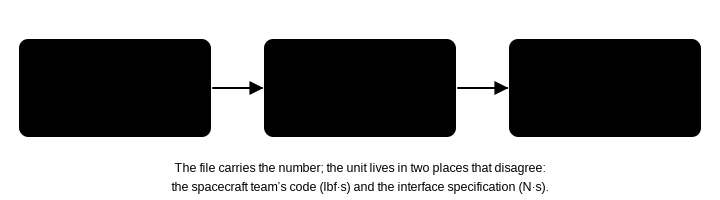
The file carried numbers. The unit lived in two places that disagreed: in the spacecraft team's code (which computed in lbf·s) and in the interface specification (which said N·s). Nobody compared them, and the data format gave no way to notice. The Board's contributing causes include that the interface specification was not followed and that navigation anomalies noticed during cruise were not escalated and resolved. The engineering lesson is structural: whenever a unit is implied rather than carried, you have an interface that can only be checked by a human reading two documents at once.
2.5 Carrying the unit in code
pint attaches a unit to a number and tracks it through arithmetic:
from pint import UnitRegistry
ureg = UnitRegistry()
Q_ = ureg.Quantity

I = Q_(0.42, "lbf * s")          # a quantity, not a number
I.to("N * s")                    # 1.868 N·s
Q_(1, "m") + Q_(1, "s")          # raises DimensionalityError
Three habits make this work in practice. One registry per program, created once and imported everywhere, because quantities from different registries cannot be combined. Convert to a plain number only at the boundary, with the unit named in the call: magnitude_in(q, "m/s"). And check dimensions at function entry, so that dynamic_pressure(v, rho) with the arguments swapped fails immediately rather than returning a number with the unit kg²/(m⁴·s²).
2.6 Worked example: a cruise condition
An airliner at 11 km, where the ISA density is 0.3639 kg/m³, cruises at 250 knots true airspeed. Dynamic pressure q = ½ ρ V². By hand: 250 kt × (1852 m)/(3600 s) = 128.6 m/s; q = 0.5 × 0.3639 × 128.6² = 3 010 Pa. Units: (kg/m³)(m²/s²) = kg/(m·s²) = N/m² = Pa. With pint, the knot-to-metre-per-second step disappears from your code and cannot be done wrongly:
q = (0.5 * Q_(0.3639, "kg/m**3") * Q_(250, "knot")**2).to("Pa") # 3009.6 PaHad you typed Q_(250, "km/h") by mistake, the answer would be 877 Pa and nothing would stop you; pint guards dimensions, not intentions. That is the limit of the tool and the reason P00.12 exists.
2.7 Three ways to carry a unit across an interface
| Where the unit lives | Example | What catches a mismatch | What does not |
|---|---|---|---|
| In documentation only | impulse: float with "N·s" in a specification document |
A person reading two documents at once | Everything automatic; this is the MCO case |
| In the name | impulse_N_s: float, a column header impulse [N*s] |
A reviewer reading the code; a parser that checks the header | Arithmetic: impulse_N_s + thrust_lbf is legal Python |
| In the data | Q_(0.42, "lbf*s"); a file row 0.42 lbf*s |
The library, on every operation | Value errors and wrong-but-dimensionally-consistent quantities |
The third row is what this lesson builds. It is not free: pint quantities are slower than NumPy arrays by a large factor in tight loops, and some libraries will not accept them. The engineering compromise, used throughout this curriculum, is to carry units through the interface (file headers, function arguments, return values) and strip them, by name, only inside numerical kernels: magnitude_in(q, "N*s") at the door, plain arrays inside, a Quantity on the way out.
A file format that would have made the MCO error impossible needs one line:
# impulse [lbf*s]
0.42
0.37
A reader that parses the header into Q_(value, header_unit) and converts to the unit it expects will either get the right number or raise. A reader that ignores the header is the 1999 reader.
2.8 A unit trap that is not an error: specific impulse
Rocket motors are rated by specific impulse, impulse per unit of propellant. Two conventions coexist. Per unit propellant mass, I_sp = I / m_p has units N·s/kg = m/s and is the exhaust velocity. Per unit propellant weight (under standard gravity), I_sp = I / (m_p g₀) has units of seconds. A motor with 2 500 m/s exhaust velocity has an I_sp of 255 s. Both are legitimate; data sheets use the second because the number is the same in SI and in pound units (lbf·s per lb is also seconds, since 1 lbf·s / 1 lb = g₀ · 1 s). A dimension check alone cannot tell you which convention a file uses, because seconds and metres per second are both valid units of "specific impulse" under different definitions. Here the unit is not enough; you must also carry the definition. P00.12 returns to this; for now, when you see I_sp in seconds, multiply by g₀ before using it as a velocity.
3. Build the computational model
Open starter/main.py. Implement the functions in the order below; python main.py prints the report once they are done.
Step 1: one registry, one Quantity constructor
ureg = UnitRegistry()
Q_ = ureg.Quantity
The tests build their quantities with impl.ureg.Quantity, i.e. with your registry, which is why it must be a module-level name.
Step 2: boundaries
def magnitude_in(q, unit):
    return float(q.to(unit).magnitude)

def round_trip(value, unit_a, unit_b):
    return magnitude_in(Q_(value, unit_a).to(unit_b), unit_a)
magnitude_in is the only place a Quantity becomes a bare number. Asking for a pressure "in metres" raises DimensionalityError inside .to, which is what you want. round_trip is the test of a conversion table: a → b → a must return the starting value to within floating-point rounding (about 10⁻¹² relative for these magnitudes).
Step 3: addition that refuses nonsense
def add_checked(a, b):
    if not isinstance(a, Quantity) or not isinstance(b, Quantity):
        raise TypeError("plain numbers carry no units")
    return a + b
pint already raises on 1 m + 1 s. The function adds one thing: it refuses a bare float, because Q_(1, "m") + 1.0 is the way units leak back out of a program (pint treats a bare number as dimensionless and raises, but the error message is confusing; a TypeError at the interface is clearer).
Step 4: formulas with dimension checks at the door
def dynamic_pressure(rho, v):
    if not rho.check("[mass] / [length] ** 3"):
        raise DimensionalityError(rho.units, "kg / m ** 3")
    if not v.check("[length] / [time]"):
        raise DimensionalityError(v.units, "m / s")
    return (0.5 * rho * v**2).to("Pa")
Quantity.check compares dimensions, not units, so slugs per cubic foot and knots pass. total_impulse(F, Δt) and delta_v(I, m) follow the same pattern. The final .to("Pa") is a second check: if the arithmetic produced anything that is not a pressure, the conversion fails.
Step 5: the Mars Climate Orbiter functions
def lbf_s_to_N_s_factor():
    return magnitude_in(Q_(1.0, "lbf * s"), "N * s")

def mco_misread_impulse(x):
    true = Q_(x, "lbf * s").to("N * s")     # what the file meant
    misread = Q_(x, "N * s")                # what the reader attached to the bare number
    return true, misread
accumulated_delta_v_error(impulses, mass) sums the firings, takes the difference between the true and misread totals, and divides by the mass with delta_v. The ratio true/misread is the same for every firing: the error is a pure scale factor, which is exactly why it was invisible in any single number.
Verify
- Analytic case:
lbf_s_to_N_s_factor()equals0.45359237 × 9.80665to 10⁻¹² relative;dynamic_pressure(1.225 kg/m³, 100 m/s)equals6125 Pa. - Round trips: ft↔m, knot↔m/s, psi↔Pa, lbf↔N, slug/ft³↔kg/m³ all return to the start.
- Conservation under change of units:
dynamic_pressurewith inputs in slug/ft³ and knots gives the same pascals as with SI inputs (physics does not depend on the unit system). - Negative cases:
add_checked(1 m, 1 s)raisesDimensionalityError;dynamic_pressure(v, rho)with arguments swapped raises;delta_v(force, mass)raises because a force is not an impulse;parse_quantity("3 furlongs_per_fortnite")raisesUndefinedUnitError. - Linearity: the accumulated error over ten identical firings is ten times that of one; doubling the mass halves it.
Compare
Do the cruise-condition example once by hand (part 2.6), once with pint, and once with "bare NumPy" where you convert knots yourself. All three agree to four figures. Now introduce a deliberate error in each: in the hand calculation forget to square the speed; in the NumPy version mistype the knot→m/s factor as 0.5114 instead of 1852/3600 = 0.5144; in the pint version pass Q_(250, "knot") as rho. Only the third one stops the program. Units libraries catch dimension errors loudly and value errors not at all; hand checks catch value errors and are slow. You need both.
4. Experiment at home, or investigate real data
Mode: data-based investigation. Read the Mars Climate Orbiter Mishap Investigation Board Phase I Report (@nasa-mco-mib, a public NASA document). Before reading, write down your prediction: in a chain of events from "a file is written in the wrong unit" to "the spacecraft is lost", how many independent opportunities to catch the error do you expect the Board to identify? Then read, and build the chain yourself as a numbered list with one sentence per link, marking each link as root cause, contributing cause, or missed opportunity, using the Board's own classification where it gives one.
Then run your code with the report in front of you. Pick an illustrative firing size (the report does not give individual impulses; 0.2–0.6 lbf·s per event is a reasonable order of magnitude for small attitude thrusters, and you should say so), an illustrative firing count for nine months of cruise, and an illustrative spacecraft mass of a few hundred kilograms. Compute accumulated_delta_v_error. You will get a number of order 1 m/s. That number is your model's output, not a mission figure: the real trajectory error depended on when each firing happened and in which direction, which a scalar sum ignores.
Raw-data format for your write-up: a table link_number, event, classification, page_reference.
5. Validate and improve
Compare your causal chain with the Board's list of contributing causes. Where you have a link the Board does not, ask whether it is a real cause or hindsight. Where the Board has one you missed, that is the useful finding: it is usually an organisational link (staffing, training, communication between teams) rather than a technical one. Unit errors are technically trivial and organisationally hard; the report's recommendations are almost all about process.
Compare the three cruise-condition calculations from part 3. If the pint result and your hand result differ in the fourth figure, find the rounding: the knot is exactly 1852 m/h, and pint uses that definition; a hand value of 0.514 m/s per knot is 0.05 % low.
Improve: make accumulated_delta_v_error accept a direction for each firing (a unit vector) and sum impulses as vectors. Observe that the missed Δv can now partially cancel, and ask what that does to your confidence in the scalar estimate.
6. Defend your work
Submit: main.py and its test output; the causal chain table; the three-way cruise comparison with the deliberate errors and which were caught; and a half-page answer to the engineering question in the metadata table. Use projects/_template/report-template.md.
Adversarial self-checks
- What if the firing count doubles? The missed
Δvdoubles; the position error after a fixed cruise time doubles. What if the mass doubles? Halves. Which of these did the MCO design actually change by having one solar array instead of two? - Which assumption fails first in the real world? Constant mass during a firing is fine; scalar summing is not, because firings in different directions partly cancel. Does that make the real error larger or smaller than your estimate? (It depends on the firing geometry; the report indicates the effect was systematic, not random.)
- What measurement could falsify the "unit error" explanation? A navigation residual history that did not show a consistent bias in the direction of the modelled small forces. The Board found residuals that did show it, and that were noticed but not resolved.
- Does the result survive a change of
pintversion or registry definitions? The lbf→N factor is a definition and will not change; the knot was redefined historically, and older registries may differ in the fourth figure. Pin the factor in a test, as this lesson does. - Which decision changes if the uncertainty in each firing's impulse were twice as large? None, if the uncertainty is random; a factor-4.45 bias is not uncertainty, and no error bar would have contained it. This is the difference between precision and correctness.
Check yourself
- State the dimension of impulse in base dimensions, and give two different units for it.
- Why is 1 lbf = 4.448 221 615 N exact rather than measured?
Q_(20, "degC") + Q_(5, "degC")raises an error inpint. Why is that the correct behaviour, and how do you express "5 °C warmer"?- A function takes
altitude_ft: float. Name the two places the unit now lives and the failure that follows when they disagree. - By what factor were the MCO small-forces impulses under-estimated, and in which direction was the resulting trajectory error (too high or too low at Mars)?
pintaccepteddynamic_pressure(Q_(0.36, "kg/m**3"), Q_(250, "km/h"))and returned 877 Pa. Was that an errorpintshould have caught? What would catch it?- Give one quantity for which a dimension check passes but the physics is still wrong, from aerospace practice.
- Why does
round_triptest to 10⁻¹² and not to exact equality?
Problem set
Attempt every problem before opening solutions/. Record what you tried. State units on every numerical answer; where a conversion is exact, say so.
1. (Warm-up: four conversions, twice)
Convert by hand, writing each factor as a fraction equal to one (e.g. 1852 m / 1 nmi), then check with pint:
(a) 35 000 ft to m (b) 250 knots to m/s (c) 29.92 inHg to Pa (d) 1 slug/ft³ to kg/m³.
Answer form: four numbers with units, the hand and pint values side by side, and the relative difference.
2. (Derivation: the pound-force and the velocity change)
(a) From the definitions 1 lb = 0.453 592 37 kg and g₀ = 9.806 65 m/s², derive 1 lbf in newtons to ten significant figures and state why no uncertainty attaches to it.
(b) Starting from Newton's second law, derive Δv = I / m for a short firing, stating the assumption that makes it exact and the condition under which it fails by more than 1 %.
(c) Show that pound-force-seconds per pound-mass has the dimension of velocity, evaluate it in m/s, and explain why I_sp in "seconds" is nevertheless meaningful.
Answer form: derivations with every unit written, two numbers.
3. (Unfamiliar scenario: the fuel order)
A datasheet gives jet fuel density as 6.7 lb/gal. A tanker is ordered to deliver 2 400 gal.
(a) What mass of fuel arrives, in kg, if "gal" is the US gallon (3.785 411 784 L)?
(b) What mass if the supplier reads it as the imperial gallon (4.546 09 L)?
(c) Write a pint expression that computes (a) and raises if someone passes the volume as a plain float.
(d) The aircraft's take-off calculation needs the fuel mass to ±2 %. Is the gallon ambiguity within that tolerance?
Answer form: two masses with units, one code snippet, a yes/no with the percentage.
4. (Numerical, uses your code: the Mars Climate Orbiter re-enactment)
Seed a generator with the last four digits of your phone number. Draw n firing impulses in lbf·s uniformly from 0.2 to 0.6, with n of your choice between 200 and 2 000, for a spacecraft of mass m of your choice between 300 and 700 kg. Using accumulated_delta_v_error, report the missed Δv. Then, treating the missed Δv as a velocity error sustained for 30 days, estimate the resulting position error in km and compare it with the ~170 km altitude error the Board reports. Say clearly which of your inputs are illustrative.
Answer form: seed, n, m, missed Δv in m/s, a position error in km, and a two-sentence comparison.
5. (Numerical, uses your code: a flight log with units)
Build a NumPy array of true airspeeds 180, 200, 220, 240, 260 knots and wrap it in a single Quantity. With ISA density at 11 km (0.3639 kg/m³), compute dynamic pressure with your dynamic_pressure in Pa and in psi, and plot it against airspeed using your P00.04 module with units on both axes. Then repeat with airspeeds mistakenly given in km/h and show the two curves on one figure.
Answer form: a table of five rows, a figure, and one sentence on how far apart the curves are and why pint did not object.
6. (Judgment: where the units library stops)
For each of the following, say whether pint catches the error, and if not, what would:
(a) adding 20 °C to 5 °C; (b) using indicated airspeed where true airspeed is required; (c) passing I_sp in seconds to a function expecting m/s; (d) a torque in N·m passed to a function expecting energy in J; (e) Q_(1, "m") + 1.0.
Answer form: five one-line verdicts with reasons.
7. (Hard: design the interface that would have saved the mission)
Write a function read_small_forces(path) -> Quantity that reads a text file of one impulse per line, requires a header line of the form # impulse [, parses the unit with your registry, and returns the impulses as a single Quantity array in N·s. It must raise a clear error if the header is missing, if the unit is not an impulse, or if any line is not a number. Write three tests: a correct lbf·s file converts to N·s with the right factor; a file with no header raises; a file whose header says [lbf] raises DimensionalityError. Then argue in one paragraph whether this interface would have been sufficient to prevent the MCO loss, using the Board's contributing causes.
Answer form: code, passing tests (use tmp_path), one paragraph.
Get the code
Clone the repository once, write your code in starter/main.py, then run the tests from the repository root.
pytest curriculum/phase-00/lesson-05-units-and-dimensionsTo run the same tests against the reference solution instead:
AEFS_IMPL=solution pytest curriculum/phase-00/lesson-05-units-and-dimensionsFound a mistake? Every page is built from the Markdown in the repository; edit it on GitHub.