P00.13 · Lesson 13 of 15
Safety & Standards for Home Experiments
Every hazard is stored energy looking for a path. Name the energy, cap it, block the path, and decide in advance when you stop.
Build it Hazard checklist and stop-criteria template
- Learning outcomes
- Identify the hazards in a proposed home experiment by listing every energy source and the path it could take to a person.
- Compute the stored or kinetic energy of a setup and decide whether it sits inside the course's home-lab envelope.
- Write controls in the order eliminate → substitute → guard → procedure → protective equipment, and write stop criteria that are observable and binary.
- Complete the nine-row safety box used by every 🔬 lesson in this course and check it with a script.
- Decide whether a proposed experiment is permitted at home, permitted with changes, or not permitted.
- Prerequisites
P00.01,P00.07,P00.10; skill check: can compute m·g·h and ½·m·v² with SI units; can write a Python function that returns a list.- Engineering question
For the falling-object timing experiment of
P00.15(a 0.2 kg ball dropped from up to 1.8 m, filmed with a phone), what can hurt someone, how much energy is involved, which controls remove the risk, and when must the session stop?
Full lesson specification (11 more items)
- Assumptions and limits
Hazard analysis here is qualitative plus simple energy bookkeeping. It assumes an adult learner, an ordinary room, and the course's envelope (below). It does not replace a regulatory risk assessment, and it cannot judge things a text checker cannot see: a wobbly table, a tired experimenter, a curious child.
- Analytical work
Energy inventory of a setup: gravitational, kinetic, elastic, electrical, thermal, chemical. Conversion between forms. Tip speed of a rotor. Why the envelope numbers are what they are.
- Computational deliverable
starter/main.py: a checker that parses asafety.mdtable, reports missing or placeholder rows, extracts the numbers in "Energy limits" with their units, and flags anything above the envelope. Tests prove it on fixture strings: complete boxes pass, each missing row is named, units convert correctly, the boundary is inclusive, and a derived stored energy is checked.- Practical activity
design-build: write the complete safety box for the
P00.15drop experiment before that lesson, run the checker on it, and fix every finding. No physical apparatus in this lesson.- Equipment
None (a computer). The safety box you write will be used with Level 1 equipment in
P00.15.- Safety
None beyond normal computer use.
- Evidence
Your completed
safety.mdfor the drop experiment, the checker's PASS report, your energy inventory table, and the problem set.- Assessment
assessments/phase-00/grading-rubric.md; competencies 1 (reasoning about energy), 3 (the checker), 4 (engineering interpretation: the permitted / not-permitted decision). A safety box with any missing row is not graded.- References
@nar-safety-coderules 1 "Materials" through 11 "Recovery Safety" (required-free): read it as a model of a good safety code, not as the rules for this course, which uses no motors.- Extensions
★ Extend the parser to battery energy in W·h and to rotor tip speed from "rpm" and a diameter. ★ Write a safety box for a tabletop fan-driven wind tunnel and defend it.
- Time
unmeasured
1. The engineering problem
In P00.15 you will drop a ball from several heights and time its fall with a phone camera. It sounds harmless, and done properly it is. But "done properly" has content. A 0.2 kg ball dropped from 1.8 m arrives at 5.9 m/s. A steel ball of the same size would be heavier and would dent a floor or a toe. A ball that bounces into a phone on a tripod breaks the phone. A tape measure stretched across the floor is a trip hazard for whoever walks in. None of these is a disaster, which is exactly why they get skipped. The habit this course needs is the habit of writing them down before every session, including the harmless ones, so that it is already automatic when the energies are larger: a tensioned rubber-band catapult in Phase 04, a fan in a cardboard wind tunnel in Phase 10, a lithium battery driving a motor in Phase 14.
The course handles this with one standard document: the safety box, a nine-row table that sits at the top of every project's safety.md and is copied into every report. The rows are fixed: Hazards, Energy limits, Controls, Supervision, Location, Regulations, Stop criteria, Disposal, and Not permitted in this project. A report whose safety box has an empty or placeholder row is not graded. That is a hard rule, so this lesson teaches you how to fill each row and gives you a script that refuses to pass an incomplete box.
The success criteria are concrete. You can list every energy source in a setup and put a number on each. You can show each number is below the home-lab envelope: the limits below which the course allows an experiment at home with no supervision. You can write a stop criterion that a stranger could apply without judgment. And you can run python main.py my-safety.md and get PASS.
A good model to study first is the National Association of Rocketry's Model Rocket Safety Code (@nar-safety-code). It governs a hobby with real stored energy, it has been refined for decades, and it is short. Notice its structure as you read: it names what may be used (materials, certified motors), how (an electrical launch system, a launch rod, a minimum angle), where (a launch-site size table scaled to the energy of the motor), what to do when something goes wrong (a wait after a misfire), and how the energy comes back down (a recovery system, no recovery from power lines). Every one of those ideas has a row in our safety box. We borrow the structure, not the rules: this course never requires combustion, a motor, or an outdoor flight.
2. Understand and derive
2.1 Hazard = energy + path
A hazard is something that can cause harm. Almost every physical hazard is stored or moving energy plus a path by which it can reach a person. The list of energy forms is short, and you should run down it every time:
| Energy form | Where it hides at home | Formula (SI) |
|---|---|---|
| Gravitational | a raised mass | E = m g h |
| Kinetic | anything moving, including a rotor tip | E = ½ m v² |
| Elastic | stretched rubber, a compressed spring, a bent ruler | E = ½ k x² |
| Electrical | batteries, chargers, mains | battery E ≈ V · Q; capacitor E = ½ C V² |
| Thermal | soldering irons, hot glue, resistors | heat flow, surface temperature |
| Chemical | glues, solvents, battery chemistry | not computed; identified and avoided |
| Pressure | inflated or pumped containers | E ≈ p V for a gas at modest overpressure |
Two more hazards do not fit the energy picture but belong in the Hazards row every time: eye (anything that can fly, snap, splash, or spray) and pinch / cut (clamps, sharp edges, knives).
Worked example (the drop test). A ball of mass m = 0.20 kg is released from h = 1.8 m. Its gravitational potential energy relative to the floor is
E = m g h = 0.20 kg × 9.81 m/s² × 1.8 m = 3.5 J.
Check the units: kg · m/s² · m = kg·m²/s² = J. At the floor, all of that is kinetic (ignoring air drag, which P00.15 shows is a small correction for this ball), so ½ m v² = 3.5 J gives v = √(2 g h) = 5.9 m/s. Is 3.5 J dangerous? A dropped 350 g smartphone from 1 m carries about the same. It hurts a bare foot, it does not injure a shod one, and it can break a screen. Hazard: falling mass, foot. Hazard: projectile (bounce), eye and equipment.
2.2 Why the envelope has the numbers it has
The course's home-lab envelope is the set of limits inside which a 🔬 lesson may be done alone at home:
| Quantity | Limit | Reason |
|---|---|---|
| Mass that can fall | 2 kg | a 2 kg mass is the heaviest thing one hand can place and release in a controlled way |
| Drop height | 2 m | reach of an adult standing on the floor; no ladders, no windows |
| Stored energy m g h | 40 J | 2 kg from 2 m is 39 J; the same as a 1 kg object at 9 m/s, which bruises but does not fracture |
| Voltage | 12 V DC | below the threshold at which dry skin conducts enough current to be felt; ordinary batteries and USB supplies qualify, mains never does |
| Current | 2 A | enough for small motors and sensors; above it, thin wires heat and short circuits burn |
| Speed of a powered or launched moving mass | 5 m/s | a brisk walk; a 50 g part at 5 m/s carries 0.6 J. Applies to rotors, springs, catapults and anything driven; a dropped object's fall speed is already bounded by the height and energy rows and is not listed in the Energy limits cell |
| Surface temperature | 60 °C | hot to touch, no burn with a brief contact; hot-glue guns and soldering irons are out of this envelope and get their own project rules |
| Gauge pressure | 0 kPa | no pressure vessels at home, ever |
These are deliberately conservative. They are not the point where injury begins; they are the point below which a careful adult alone at home has margin. Later projects that need more (a guarded fan, a soldering iron) carry their own safety box with a justified, larger limit for that single quantity and extra controls. The checker accepts a different envelope dictionary for that case, but the default is this table.
Why voltage and current are separate limits. Harm from electricity is set by current through the body, and current is voltage divided by body resistance. Dry skin has a resistance of tens of thousands of ohms, so 12 V drives well under a milliampere: not felt. Mains at 230 V (or 120 V) drives tens of milliamperes, which can stop breathing. The separate current limit protects the equipment: a 2 A source into a short circuit heats a thin wire to the point of melting insulation. A battery that can deliver 20 A into a short (a lithium pouch cell can) is a fire hazard even at 3.7 V. That is why batteries get their own paragraph below.
Why speed is its own limit. Kinetic energy alone misleads for rotors. A 100 mm propeller at 3000 rev/min has a tip speed of
v = ω r = (2π × 3000 / 60 s⁻¹) × 0.050 m = 15.7 m/s,
far above 5 m/s, yet its kinetic energy is small because the blade is light. What hurts is the edge speed and the cut, not the joules. So an unguarded rotor is never permitted at home, and any rotor at all appears only inside a mesh enclosure in a project with its own safety box.
2.3 Controls: the hierarchy
A control is a measure that reduces risk. List them in a fixed order, because the order is also a ranking of how much they can be trusted:
- Eliminate the hazard. Do not use a steel ball when a tennis ball answers the same question.
- Substitute a lower energy. Drop from 1.2 m instead of 1.8 m if the camera still resolves the fall.
- Engineer a barrier. A landing mat; a clamp instead of a hand; a mesh guard; a fuse; a tether on anything that could fly.
- Administer a procedure. An exclusion circle on the floor; a "clear!" call before release; one person releases and the same person says when it is safe.
- Protect the person. Safety glasses, closed shoes. Last, because it only works if worn, and only for the person wearing it.
Safety glasses are required for any experiment with a projectile, a snapping or flying part, a spring under load, a drill, or a battery being connected. For the drop test that means the ball could bounce toward your face: glasses on.
2.4 Stop criteria
A stop criterion is a condition that, when it is met, ends the session immediately and without discussion. It must be observable (you can see, hear, smell, or read it) and binary (it is met or it is not). "Be careful if the ball bounces oddly" is not a stop criterion. "Anyone, including a pet, enters the 1 m circle" is. So is "any reading outside the envelope", "the battery is warm to the touch", "a crack appears in the fixture", and "I am tired or rushed". Write the last one. It is the most common real cause of an accident.
When a stop criterion is met: stop, make the setup safe (put the mass down, disconnect the battery, release the spring), and only then think about what happened.
2.5 Two topics that need their own words
Batteries. Alkaline AA cells store roughly 10 kJ each and release it slowly; they are safe to handle, must not be shorted (a shorted AA gets hot enough to burn skin), and go to a collection point when dead. Lithium-ion cells (phone, power bank, hobby packs) store similar energy per cell but can release it in seconds if shorted, punctured, over-charged, or crushed, and the result is fire. Rules in this course: use lithium cells only inside their original protected product (a phone, a power bank with a USB socket) or a pack with a protection circuit; never solder to a cell; never charge unattended; a swollen, hot, or dented cell is a stop criterion and goes to a battery collection point in a metal or ceramic container, not in household waste.
Moving parts. Anything that rotates or reciprocates gets a guard the fingers cannot pass through before it is powered. Long hair and loose sleeves are tied back. The power is disconnected, not just switched off, before a hand goes near a mechanism.
2.6 Reading the NAR code as a code
Go through @nar-safety-code rules 1 to 11 and, for each, write the row of our safety box it corresponds to. You will find: materials and motors → Not permitted (only certified, only lightweight), ignition system and misfires → Controls and Stop criteria (an electrical system with a safety interlock, a wait after a misfire), launch safety → Controls and Supervision (a countdown, a minimum distance), launcher → Controls (a blast deflector, a launch rod with its tip protected), size and flight safety → Energy limits (a mass and impulse cap, no flight at targets or into clouds), launch site → Location (a distance table scaled to motor power), recovery → Controls and Disposal. The point of the exercise is to see that the nine rows are not bureaucracy. They are the questions every mature safety code has ended up answering.
3. Build the computational model
The deliverable is a completeness checker: a script that turns the rule "no report is graded with an incomplete safety box" into something a computer applies the same way every time. It is a text tool, not a physics model, so its tests are fixture strings.
Step 1: Parse the table
A safety box is a Markdown table with two columns. Each data row is | **Label** | text |. We want a dictionary from label to cell text.
def parse_safety_box(text: str) -> dict[str, str]:
    rows: dict[str, str] = {}
    for line in text.splitlines():
        line = line.strip()
        if not (line.startswith("|") and line.endswith("|")):
            continue
        cells = [c.strip() for c in line.strip("|").split("|")]
        if len(cells) < 2:
            continue
        label = cells[0].strip("*").strip()
        if not label or set(label) <= set("-: "):   # blank header or |---|---| separator
            continue
        rows.setdefault(label, cells[1].strip())
    return rows
strip("*") removes the bold markers; the set(label) <= set("-: ") test discards separator rows. setdefault keeps the first occurrence if a label is repeated.
Step 2: Find the missing rows
A row is missing if its label is absent, or if its cell still holds a placeholder such as … or TBD. Compare case-insensitively so energy limits and Energy limits are the same row.
PLACEHOLDERS = frozenset({"", "…", "...", "tbd", "todo", "n/a", "na", "-", "?"})

def missing_rows(box, required=REQUIRED_ROWS):
    lowered = {k.lower(): v for k, v in box.items()}
    out = []
    for label in required:
        value = lowered.get(label.lower())
        if value is None or value.strip().strip(".").lower() in PLACEHOLDERS:
            out.append(label)
return outStep 3: Read the numbers in "Energy limits"
The cell is free text: "mass 0.5 kg, drop height 1.2 m, 9 V battery, 500 mA". We want {"mass_kg": 0.5, "drop_height_m": 1.2, "voltage_v": 9.0, "current_a": 0.5}. A regular expression finds number + unit pairs; a table maps each unit to a key and a conversion factor. Order matters: m/s must be tried before m, and mA before m and A, or "500 mA" is read as 500 m. Keep the maximum when a quantity appears twice, because the envelope is a ceiling.
_UNIT_TABLE = (
    (r"m/s", "speed_m_s", 1.0), (r"km/h", "speed_m_s", 1/3.6),
    (r"°\s*C", "temperature_c", 1.0), (r"kPa", "pressure_kpa", 1.0),
    (r"mA", "current_a", 1e-3), (r"kg", "mass_kg", 1.0), (r"g", "mass_kg", 1e-3),
    (r"mm", "drop_height_m", 1e-3), (r"cm", "drop_height_m", 1e-2), (r"m", "drop_height_m", 1.0),
    (r"V", "voltage_v", 1.0), (r"A", "current_a", 1.0),
)
Build one regex with a named group per unit, then for each match find which group fired. Add a negative look-ahead (?![A-Za-z/]) after the unit so m does not match the start of mass.
Step 4: Compare with the envelope
def check_envelope(limits, envelope=HOME_LAB_ENVELOPE):
    exceeded = [k for k, v in limits.items() if k in envelope and v > envelope[k]]
    if "mass_kg" in limits and "drop_height_m" in limits:
        if limits["mass_kg"] * G0 * limits["drop_height_m"] > envelope["energy_j"]:
            exceeded.append("energy_j")
    return exceeded
The comparison is strict (>), so a value equal to the limit passes: the envelope is inclusive. The stored-energy line is the one piece of physics in the tool: a mass and a height together imply an energy, and the energy has its own limit.
Step 5: Report
check_safety_box ties the steps together and returns a SafetyReport with missing, limits, exceeded, an ok property, and a format() method that prints one finding per line and ends with PASS or FAIL.
Verify
The tests in tests/test_main.py use fixture strings and check behaviour, not numbers from a file:
- a complete box passes with nothing missing and nothing exceeded;
- deleting one row names exactly that row; a
…cell counts as missing; a template-like box lists all nine rows in order; - each unit converts to the right key and factor (
250 g→ 0.25 kg,36 km/h→ 10 m/s,1,5 kg→ 1.5 kg); 3 m/sdoes not create a height,500 mAdoes not create a height or a mass;- values exactly at the envelope pass and 1 % above fail;
- 2 kg at 2.0 m (39.2 J) passes but 2 kg at 2.1 m trips both the height and the derived energy;
- a custom envelope is respected.
Run pytest curriculum/phase-00/lesson-13-safety-for-home-experiments and make every test pass.
Compare
There is no established library for this job, so the comparison is against a human review. Give your safety box for the drop test to someone else with the template open and ask them to mark every row they would reject. Then run the checker. The checker will catch every structural problem the reviewer catches (missing rows, numbers over the envelope) and none of the substantive ones (a control that does not actually control the hazard, a stop criterion that needs judgment). That gap is the subject of part 5.
4. Experiment at home, or investigate real data
Mode: design-build (a document). There is no apparatus in this lesson. The product is the safety box you will use in P00.15.
A safety box is easier to write with the floor plan in front of you. Sketch yours; the drop test's looks like this from above:
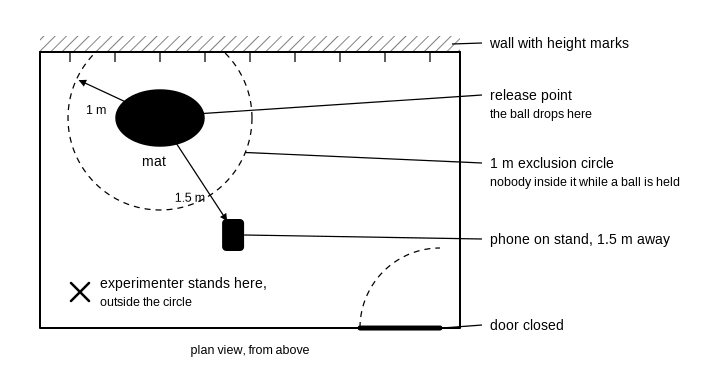
Every control in the box should be visible in this picture (the mat, the circle, the distance to the phone, the closed door) or be something a person wears or does (glasses, the "clear" call). If a control cannot be drawn or acted, it is probably a wish, not a control.
- Copy the table from
projects/_template/safety.mdinto a new filemy-drop-test-safety.md. - Fill the Energy inventory first, on paper: the ball's mass, the greatest height you will use, m g h, the impact speed √(2 g h), the phone's battery voltage. Write each number with its unit.
- Fill the nine rows. For Hazards, go down the table in §2.1 and write one line per energy form that is present, plus eye and pinch. For Controls, write them in hierarchy order. For Stop criteria, write at least three, each observable and binary, and include "I am tired or rushed".
- Run
python curriculum/phase-00/lesson-13-safety-for-home-experiments/starter/main.py my-drop-test-safety.md. Fix everyMISSINGand everyOVER ENVELOPEline until the report saysPASS. - Keep the file.
projects/p00-first-experiment/safety.md(written for the course) is the reference; compare yours against it when you reachP00.15and note what you missed.
5. Validate and improve
Run the checker on the raw template projects/_template/safety.md. It should fail with every row reported missing, because every cell is an instruction rather than content. Now run it on your drop-test box. It passes. Does that make the experiment safe?
No. Compare what the two checks can see. The script can see structure (all rows present, no placeholders) and magnitude (numbers inside the envelope). It cannot see validity. A Controls cell that says "be careful" passes the checker and controls nothing. A Stop criteria cell that says "if it looks dangerous" passes the checker and is not a criterion. An Energy limits cell that says "a small ball from head height" passes the checker (no numbers, so nothing exceeds) while hiding the fact that you have not computed anything.
Improve the box, not the checker, to close that gap: every control names the hazard it controls ("mat: falling mass; glasses: bounce to eye"), every stop criterion could be applied by a stranger, and Energy limits always carries numbers with units so the envelope check has something to bite on. Then improve the checker in one honest way: make it report when the Energy limits cell contains no parsable number at all, since a limit without a number is not a limit. (That is Problem 4.)
Where does this approach fail? The envelope is tuned for an adult alone in an ordinary room. It is not tuned for a child, for a cramped space, or for a shared flat where someone can walk in. Supervision and Location rows exist to carry exactly that information, and no number in the envelope substitutes for them.
6. Defend your work
Submit: your energy inventory table, your completed my-drop-test-safety.md, the checker's PASS output, your passing test run, and the problem set. A short note (five sentences) on what the checker could not catch in your box and how you closed that gap by writing.
Adversarial self-checks
- What if the mass doubles? The energy doubles; does any control change, and does the envelope still hold? What if the height doubles instead?
- What if the ball is replaced by a steel bearing of the same diameter (about eight times the mass)? Which row changes first?
- Which assumption fails first in the real world: the adult alone, the clear floor, or the stated height?
- What observation would show that your stop criteria were not binary: that two people would disagree on whether one was met?
- Does the checker's verdict survive rewording the Energy limits cell ("1.8 metres" instead of "1.8 m")? If not, is that a bug in the parser or a rule for how the cell must be written?
- Which decision would change if your estimate of the drop height were off by a factor of two?
Check yourself
- Define hazard and control in one sentence each.
- A 0.5 kg bag of rice is lifted to 1.5 m. What energy does it store, in joules, and is that inside the envelope?
- Why does the envelope limit voltage and current separately?
- Give the formula for the tip speed of a rotor of radius r turning at n revolutions per minute.
- Which of these is a valid stop criterion, and why: (a) "if the setup seems unstable", (b) "if the clamp moves by any visible amount", (c) "if someone enters the room"?
- Put these controls in hierarchy order: safety glasses, using a lighter ball, a landing mat, an exclusion circle.
- The checker passes a box whose Controls cell reads "take care". What kind of error is that: a false pass, a false fail, or neither?
- Name two things about a lithium-ion cell that are stop criteria.
Problem set
Attempt every problem before opening solutions/. Record what you tried. State units on every number.
1. (Warm-up: the energy inventory)
A tennis ball (m = 0.058 kg), a baseball (0.145 kg), a 0.5 kg bag of rice, and a 2.0 kg bag of flour are each held at h = 1.5 m above the floor.
Find, for each: the stored energy m g h in joules and the impact speed √(2 g h) in m/s (ignore drag). Then state which of the four would still be inside the envelope at h = 2.0 m. Answer form: a four-row table with units, then one sentence.
2. (Derivation: the shape of the envelope)
The envelope caps the falling mass at 2 kg, the height at 2 m, and the stored energy at 40 J.
(a) Show that the mass and height limits alone already keep m g h below 40 J, so the energy row is redundant for a dropped object. (b) Now consider a thrown or launched object, which has kinetic energy that does not come from a drop. Derive the speed v at which a 0.5 kg object reaches 40 J, and the speed at which a 0.05 kg object does. Compare both with the 5 m/s speed limit and explain in two sentences why the course needs a speed limit and an energy limit rather than either alone.
3. (Unfamiliar scenario: a rubber-band catapult)
A later lesson launches a foam glider with a rubber band that behaves like a spring with k = 60 N/m, stretched by x = 0.25 m.
(a) Compute the elastic energy ½ k x² and the launch speed of a 0.020 kg glider if all of it becomes kinetic energy. (b) Write the Hazards row and the Controls row of a safety box for this launch, with the controls in hierarchy order and each control naming the hazard it addresses. (c) Write three stop criteria. For each, say how a bystander would know it was met.
4. (Numerical: uses your code)
Save the following text as bad-box.md and run python starter/main.py bad-box.md.
| | |
|---|---|
| **Hazards** | falling mass. |
| **Energy limits** | a small ball from head height, 9 V battery. |
| **Controls** | be careful. |
| **Supervision** | … |
| **Location** | kitchen. |
| **Stop criteria** | if it looks dangerous. |
| **Disposal** | TBD |
| **Not permitted in this project** | ladders. |
(a) List every finding the checker reports.
(b) List every problem with this box that the checker does not report, and say for each why a text checker cannot see it.
(c) Add one honest improvement to the checker: when the Energy limits cell contains no parsable number at all, report "Energy limits (no numeric limit)" in missing. Write a test for it in tests/test_main.py, make it pass, and confirm all the existing tests still pass.
(d) Rewrite the box so that it passes and fixes every item from (b).
5. (Judgment: a battery that stores a thousand times the envelope)
Look up (or read off the label of) your own phone's battery: a capacity Q in mA·h and a nominal voltage V (typically 3.8 V). Its stored energy is E ≈ Q · V, converted to joules (1 mA·h × 1 V = 3.6 J).
(a) Compute E for your phone. Compare it with the 40 J stored-energy limit. (b) The course permits a phone on a tripod in the drop experiment. Explain, in terms of energy and path, why an object storing roughly a thousand times the envelope is permitted while a 2.5 kg mass at 2 m is not. (c) Write the Energy limits row, the Stop criteria row, and the Disposal row for a project that powers a small fan from a USB power bank (5 V, up to 2 A).
6. (Design and defence: a guarded fan)
A Phase 10 project uses a 120 mm computer fan (12 V, 0.3 A, up to 2000 rev/min) inside a cardboard duct to measure the drag on a model.
(a) Compute the blade tip speed in m/s and compare it with the 5 m/s speed limit. Is the fan permitted under the default envelope? Under what single change to the envelope and which added controls could a project justify it?
(b) Write the complete nine-row safety box for this project. Run the checker on it with the default envelope, note which quantity it flags, then run it with an envelope dictionary that raises only that one quantity and explain in writing why the raise is justified by the controls you wrote.
7. (Reading a code: the NAR safety code as a model)
Read @nar-safety-code rules 1 to 11. Produce a two-column table mapping each rule to the row(s) of our safety box it most resembles, and name one rule whose form (not its content) you would want to copy into a home-experiment code and why. Then state, in one sentence each, two reasons why the NAR code itself is not the safety code for this course.
Get the code
Clone the repository once, write your code in starter/main.py, then run the tests from the repository root.
pytest curriculum/phase-00/lesson-13-safety-for-home-experimentsTo run the same tests against the reference solution instead:
AEFS_IMPL=solution pytest curriculum/phase-00/lesson-13-safety-for-home-experimentsFound a mistake? Every page is built from the Markdown in the repository; edit it on GitHub.